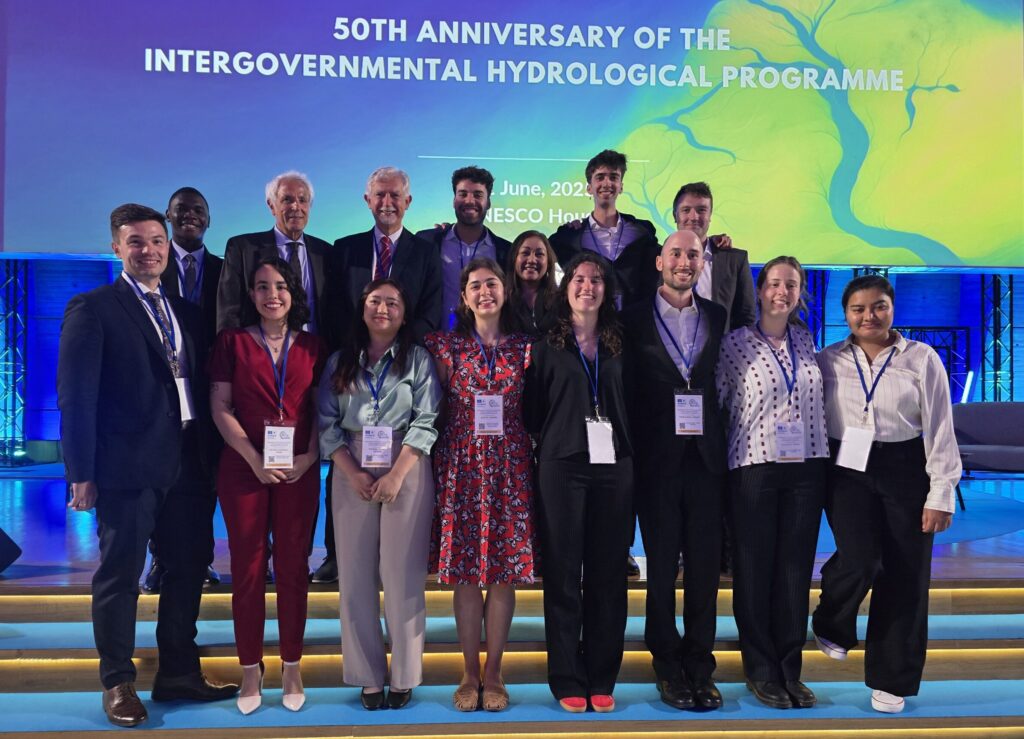
Between the 11th – 13th June, UNESCO celebrated 50 years of the International Hydrological Programme (IHP) through a series of events and performances at the UNESCO headquarters in Paris. The IHP has been pivotal in global water security for the past half century, as it is the only UN intergovernmental initiative dedicated to water.
In addition to this milestone event, 16 members of the Ecohydrology Youth Network (EHYN) attended the conference with many being a part of the 1st UNESCO Water Youth Dialogue – a platform dedicated to empowering youth to lead and co-create solution for global water challenges. The first day was centred on welcoming remarks, with Ms Audrey Azoulay, Director-General of UNESCO, opening the ceremony. For EHYN, the highlight was our very own Nicole Rivera speaking on the Water Family Panel, discussing the IHP 50-year strategic vision (Photo 1). Not only did Rivera represent EHYN, but she also spoke on the importance of including local voices in actions and related to her personal experience in Bolivia. Rivera emphasised the voice of the youth for the future of water, for EHYN and as a voice for young people on a global scale due to the importance and scale of water related issues.
Young voices continued to hold importance at the conference, with the 1st UNESCO Water Youth Dialogue. The Dialogue kicked off on the second day, Thursday, with a series of sessions throughout the day. After opening remarks, 3 main sessions took place: Pushing Water up in the International Agenda, The future of International Water Cooperation and Diplomacy and an Experts Consultation Session. The EHYN members were a part of a team of over 50 young water leaders, working together to discuss global water issues, and to co-develop strategies for solutions.
Simultaneously, the Ecohydrology Symposium took place on Thursday afternoon with the opening remarks being made by Dr. Rahmah Elfithri, Chief of Section for Capacity Development and Water Family Coordination (CDW) in the Division of Water Sciences. The session continued with a series of informative keynotes, provided by Prof. Maciej Zalewski: ‘Why Transdisciplinary ecohydrology becomes the Rocket Science for SDG acceleration’, Dr. Antonio Donato Nobre: ‘The Biotic Pump’, and Prof. Karl Mattias Wantzen: ‘River Culture: Human/River Connectivity to discover and implement ecohydrological solutions’. These topics provided insight on ecohydrology, coming from different perspectives, yet all being thought-provoking.
The next part of the symposium consisted of a Panel Discussion, moderated by Elfithri. With 6 panellists, the discussion focused on 2 questions: ‘What added value transdisciplinary ecohydrology has been providing to the IHP and water sciences?’ and ‘What should be the synergies of transdisciplinary ecohydrology with water, environment and sustainability sciences?’. After an interesting an engaging 2 hours of discussion, it was time for a coffee break, which gave EHYN attendees a chance to discuss and reflect on the themes and topics presented thus far.
The symposium continued with another small series of keynote speeches, ‘Global Networks of UNESCO Ecohydrology Demonstration Sites’, Ecohydrology Lab Network’ and ‘Ecohydrology Youth Network’. The latter was presented by dr. Paweł Jarosiewicz, the President of EHYN. A presentation session followed, with the focus being on the activities and developments of UNESCO Ecohydrology Demonstration Sites, with presenters from all corners of the world. This marked the end of the symposium and day 2 on a high as it celebrated some of the extraordinary work in the scope of ecohydrology thus far. Many members of EHYN attended the Ecohydrology Symposium and found the afternoon to be inspiring due to the large array of presenters and insights, on a global scale. Despite the day of the conference being over, conversations did not stop just yet. The EHYN members involved in the Water Youth Dialogue attended an evening dinner. Along with good food and fantastic views from the top floor on the UNESCO headquarters, it was a chance to connect with the other participants of the Youth Dialogue and spread the word on ecohydrology.
The final day of the conference saw the continuation and closure of the Youth Dialogue, with the launch of the co-draft of the Water Youth Strategy. This focuses on the investment of capacity development, enhancing professional opportunities and creating formal mechanisms for young participation. EHYN was honoured to be involved in such a pivotal moment of youth involvement within the IHP, alongside the anniversary celebrations. Alongside this achievement, EHYN members embraced the opportunity to meet other young people passionate about the future of water given the global challenges and create connections and share insights with other attendees from across the globe.
The 3-day event at the UNESCO headquarters was a true celebration of the work on water through the IHP over the last 50 years. On that day EHYN members met with dr. Elfithri Rahman to discuss future plans of the network. With the EHYN being involved in the 1st UNESCO Youth Water Dialogue, contributing to the future works in the water sector and the presentation of the current notions in the scope of ecohydrology, it is sure that ecohydrology and young people will be apart of positive future change for water security for all.