May 14, 2026
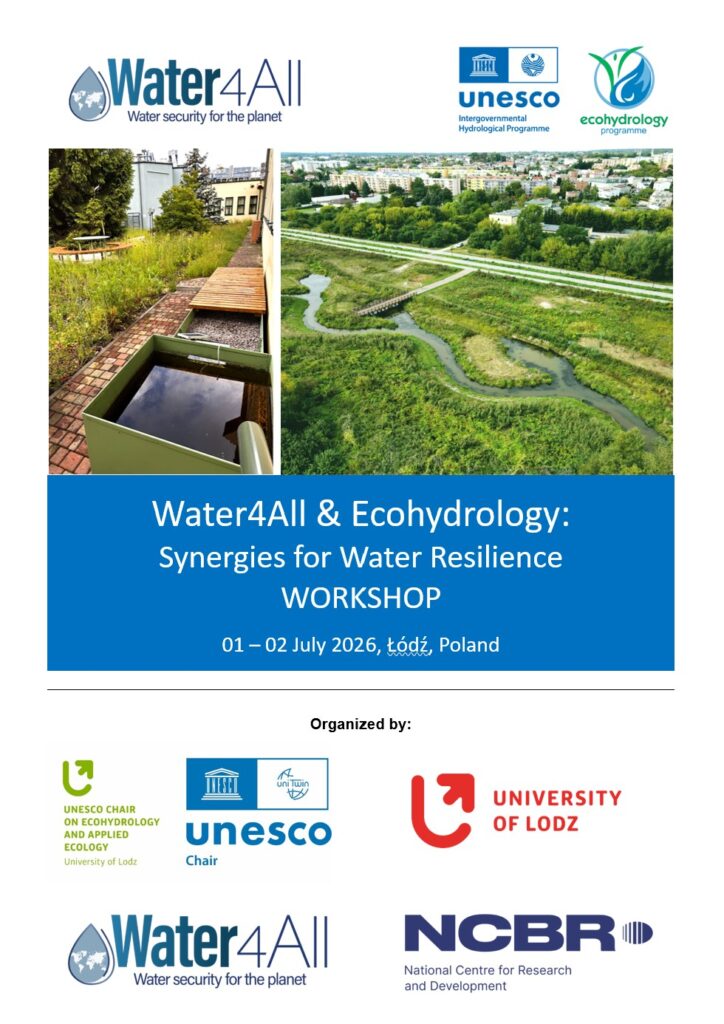
Water4All & Ecohydrology: Synergies for Water Resilience – WORKSHOP
The meeting aims to provide a dedicated platform for Water4All projects to exchange knowledge, identify synergies, and strengthen...
Reversing degradation of water resources and stopping further decline in biodiversity through the optimization of ecosystem services.
The meeting aims to provide a dedicated platform for Water4All projects to exchange knowledge, identify synergies, and strengthen...
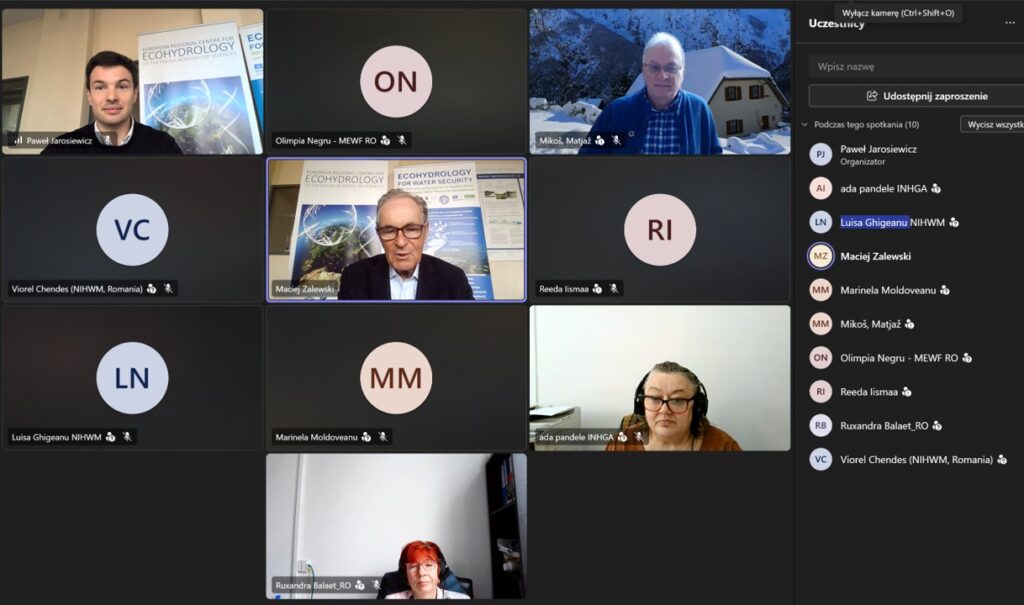
On 27 February 2026, the European Regional Centre for Ecohydrology (ERCE) in Łódź hosted a hybrid meeting of...

The UNESCO Ecohydrology Programme was officially introduced into the Intergovernmental Hydrological Programme (IHP) in 1996 as a scientific...
In the face of increasing climate instability, demographic growth and human migrations, and the emergence of new geopolitical centres, which will affect the global economy (including increase of food prices and intensified environmental impact), there is an urgent need to reverse degradation of water resources and stop further decline in biodiversity. Appreciation and optimization of ecosystem services for society along with enhancement of resilience of river basins to climatic and anthropogenic stress may greatly contribute to reach this goal.
In the Anthropocene, most of the global landscape, except deserts, high mountains and the boreal zone, has been converted into agricultural land with spots of highly modified urban areas. This over-engineering of urban and agricultural landscapes results in a reduction of biomass and organic matter, leading to a modification of the water cycle from the model situation where biological component stabilizes the heat budget and water dynamics at the intermediate disturbance level, to a model where the water cycle accelerates and becomes more stochastic and unfavourable for biota and humanity (droughts and catastrophic floods).
Additionally, these processes reduce carbon storage and nutrients transfer from mineral to organic forms, impacting the material cycle. To reverse those negative processes, a two-steps strategy has to be elaborated and implemented.
Von Weizsäcker’s Reduction The first proposed step should be based on Von Weizsäcker’s reduction of energy and matter use per GDP.
Ecohydrology Theory The second proposed step is based on Ecohydrology theory to regulate hydrological and nutrients’ cycles in “novel ecosystems” (agricultural and urban) towards the enhancement of carrying capacity of the global ecosystem.
"Carrying capacity enhancement is understood as the enhancement related to water resources, biodiversity, ecosystem services for societies and the resilience to increasing various forms of impact."
Since 2011 UNESCO-IHP promotes the establishment of various demonstration sites around the world to apply Ecohydrology solutions in watersheds at all scales. Each demonstration site aims to apply Ecohydrology principles and solutions to solve both social and environmental issues.
These solution-oriented projects and methodologies are shown in this web-platform to disseminate the acquired information to UNESCO’s Member States and the general public. This information will allow to apply an Integrated Water Management in other locations. The demonstration sites and their main characteristics (including related scientific papers, etc.) are synthesized and are available to access through the following list or map visualization.

Explore solutions implemented in diverse watersheds globally.
UNESCO and related organizations are organizing events around the world. Here you will find the links to some of them. For other queries and general questions related to the conferences, including requests for invitation letters, please contact the organizers directly.
If you are part of a Water4All project and your work is connected to Nature-based Solutions (NbS) or Ecohydrology, this workshop is for you. During the meeting, we will:
Global Celebration of the 30th Anniversary of Ecohydrology at UNESCO and 20 Years of UNESCO Ecohydrology Demonstration Sites IntroductionThe “Global celebration of the 30th Anniversary of Ecohydrology at UNESCO and 20 years of UNESCO Ecohydrology Demonstration Sites” will be organized as a special session of the 27th Session of the IHP Intergovernmental Council held in […]
The International Conference on Ecohydrology seeks to bring together the international scientific and educational communities...
If you have a long-term engagement with a solution-oriented project that applies a ecohydrological implementation principle, you are welcome to postulate to the Ecohydrology Network.
The main benefit of being part of the network is the visibility that the project can get, deploying to a wider audience: more people can know the project. Every year UNESCO-IHP and specifically the Ecohydrology Programme reach several seminars and related events around the world disseminating the Ecohydrology concept and the demonstration sites information.
Additional, an intangible good reputation is acquired by projects inside of the network, an additional value regarding founds solicitation.Application to become a UNESCO Ecohydrology Demonstration Site will be done through on-line questionnaire.
First step: provide a main description of the demonstration site that will be submitted to the Scientific Advisory Committee.
Second step: If accepted, you’ll have access to the EH Technical Form, a second and more detailed questionnaire (8 sections).
"Demonstration cards" will be constructed through an automatic user friendly process.

The web-platform contains information about the Ecohydrology demonstration sites and their main characteristics (including related scientific papers etc.), major ecohydrology-related events, funding opportunities and a link to apply to the Ecohydrology network. Application to become a UNESCO Ecohydrology Demonstration site can be done through the web platform and “demosite cards” will be constructed through an automatic user-friendly process. The web platform will bring a new, unified-format visualization of the works done separately on each demosite, also playing the role of a shared platform to bring together the related scientific projects and to revitalize the network.