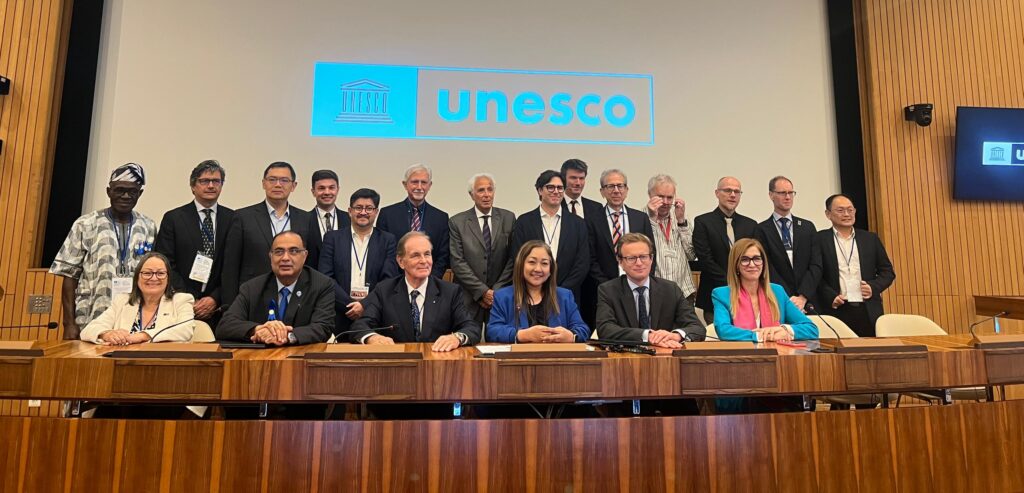
On the 50th anniversary of the UNESCO IHP and 60 years of UNESCO water science, the Capacity Development and Water Family Coordination (CDW) section of the IHP hosted a side event, ‘Ecohydrology Symposium,’ on June 12, 2025. The event was held in a hybrid format and gathered 30 experts, 77 early-career researchers, and MAEH students at UNESCO HQ in Paris, with a global audience attending online. The symposium started with welcoming remarks by Dr. Elfithri Rahmah, Chief of the CDW Section, who greeted participants and outlined the event’s goals. The official session was opened by H.E. Mariusz Lewicki, Permanent Representative of the Republic of Poland to UNESCO, who praised the work of Dr. Rahmah and her colleagues at the IHP Secretariat. In his opening speech, Mr. Lewicki highlighted the strong link between science and culture, noting that in the acronym UNESCO, the letter ‘S’ stands for Science, followed by ‘C’ for Culture, symbolizing their interconnectedness. He described ecohydrology as a holistic and transdisciplinary approach to hydrology.
The first keynote session, titled “Why Transdisciplinary Ecohydrology Becomes the Rocket Science for SDG Acceleration,” was delivered by Professor Maciej Zalewski, one of the founding members of the Ecohydrology (EH) Programme at UNESCO. He emphasized the role of Transdisciplinary Ecohydrology (TEH) in enhancing natural processes to support sustainability, particularly in the context of a rapidly growing global population. Professor Zalewski explained that TEH is the outcome of integrating Sociocentric/Mechanistic and Evolutionary Ecosystem Paradigms, making it a powerful approach for addressing complex environmental challenges. He also presented a comprehensive framework for applying TEH to Integrated Water Resources Management (IWRM), demonstrating its potential to align ecological, social, and technical dimensions. Furthermore, he highlighted the crucial role of youth engagement in advancing TEH, encouraging the next generation of scientists and practitioners to contribute to its development and implementation.
The second keynote session was delivered by Professor Karl Matthias Wantzen, who spoke on the role of river culture in supporting the implementation of EH as both a cultural and educational framework. He emphasized that integrating local cultural practices and values into ecohydrological approaches can significantly enhance their effectiveness and acceptance at the community level. Professor Wantzen highlighted the symbolic significance of the letters “C” (Culture) and “E” (Education) within the word Ecohydrology, underscoring the importance of these elements in promoting a sustainable and holistic approach to water management. He illustrated the concept of cultural and spiritual connectivity with riverscapes by referencing the Andean philosophy of Pachamama, which reflects a deep reverence for nature and the interconnectedness of humans and ecosystems. He emphasized that people should follow the River Culture Concept i.e. learn from the river to live with the river, to feel and love the river.
The third keynote speaker, Dr. Rahmah Elfithri, delivered a talk about the global network of UNESCO EH demonstration sites. She highlighted the evolution of EH throughout the different phases of the International Hydrological Programme (IHP), with a particular focus on the 9th Phase, during which UNESCO launched a global call for EH Demonstration Sites. This initiative promotes the application of ecohydrological approaches as nature-based solutions to help achieve a water-secure world, especially in the face of growing climate change challenges. As of 2025, 36 countries have adopted EH-based approaches to address various social and environmental issues related to water, contributing to improved Integrated Water Resources Management (IWRM) across 65 demonstration sites. Of these, 26 sites are situated in basins, cities, or urban areas; 13 in inland wetlands; 18 in river and lake systems; and 6 in estuaries and coastal waters. All these sites apply diverse EH methodologies, with a common emphasis on the dual regulation method, which integrates hydrological and ecological processes to enhance water quality, biodiversity, and community resilience.
The last two keynote speakers, Dr. Stefano Fazi and Dr. Pawel Jarosiewicz, delivered presentations on two new EH initiatives: the Ecohydrology Lab Network and the Ecohydrology Youth Network (EHYN). These initiatives aim to strengthen collaboration among research institutions and empower the next generation of water professionals through capacity-building, knowledge exchange, and youth engagement. Both speakers emphasized that fostering innovation and inclusivity is essential for scaling up EH solutions worldwide and ensuring long-term impact.
The EH symposium featured a panel discussion titled “What Added Value Has Transdisciplinary EH Brought to the IHP and Water Sciences?” The panel also explored future directions by asking, “What should be the synergies between transdisciplinary EH and water, environment, and sustainability sciences?” The discussion brought together distinguished experts and thought leaders who shared perspectives on integrating EH more deeply into global water governance and interdisciplinary research. Panelists emphasized the growing need for collaboration across scientific, policy, and community domains to maximize ecohydrology’s transformative potential.
The event ended with a presentation session showcasing a diverse array of EH activities and UNESCO EH Demonstration Sites from around the world. Moderated by Mr. Giuseppe Arduino (UNESCO Chair at the University of Algarve), the session highlighted the ground applications of ecohydrology in countries including Portugal, China, Ecuador, Tunisia, the UK, Kenya, Indonesia, Malaysia, Costa Rica (only women-led demosite), Colombia, and the Republic of Korea. Each presentation demonstrated how ecohydrology is being used as a tool for research, education, cultural integration, and sustainable water management, tailored to local environmental and societal contexts.
These sessions offered compelling insights into the real-world impact of ecohydrology and underlined its adaptability across diverse ecosystems, from urban catchments to ancestral landscapes and coastal lagoons. They also reinforced the value of knowledge exchange and international collaboration in scaling up nature-based solutions globally. The symposium also stressed the role of capacity-building, youth engagement, and inclusive policy frameworks in scaling up ecohydrology across regions.