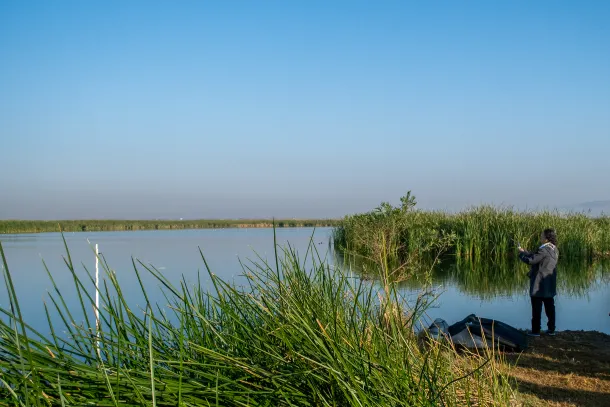
The “Amunas” of the Carhuayumac micro-basin, water sowing practices of San Pedro de Casta in Huarochiri, Lima. Peru.

Back to List
Updated: 17/12/2025
The “Amunas” of the Carhuayumac micro-basin, water sowing practices of San Pedro de Casta in Huarochiri, Lima. Peru.

Project Overview

The hydrographic unit corresponds to the Carhuayumac micro-basin with an area of 58 square kilometers, which is embedded in the Santa Eulalia sub-basin with a total area of 1077.38 square kilometers, which in turn represents 30.75% of the total area of the Rímac basin, major siver supplying water to Lima.

Conserve Process YES
Enhance Process YES
Apply Complementary NO

Ecosystem Services

Provisioning

  • Provisioning Services are ecosystem services that describe the material or energy outputs from ecosystems. They include food, water and other resources.

Regulating

  • Regulating Services are the services that ecosystems provide by acting as regulators eg. regulating the quality of air and soil or by providing flood and disease control.

Habitat / Supporting

  • Ecosystem services "that are necessary for the production of all other ecosystem services". These include services such as nutrient recycling, primary production and soil formation.

Cultural

  • Cultural Services corresponds nonmaterial benefits people obtain from ecosystems through spiritual enrichment, cognitive development, reflection, recreation, and aesthetic experiences.

Major Issues

No issues provided.

EH Engineering Solutions

The ecohydrological infrastructure in this case is

The ecohydrological infrastructure in this case is the traditional Andean water management systems known as amunas. These systems serve as a form of ecohydrological infrastructure designed to regulate hydrological processes, including runoff speed, infiltration, and recharge. The strategic redirection of water by amunas influences the landscape's water dynamics, which, in turn, interact with the surrounding vegetation.

The environmental/hydrological flow, considered as the natural

The environmental/hydrological flow, considered as the natural flow, fluctuates between 0.09 m3/s during the dry season (June) and 1.04 m3/s

Project Activities

  • Currently, the main activities in the site, carried out by Aquafondo as its mandate, include the maintenance, operation and monitoring of the amunas. Specifically, these activities refer to the infrastructure, monitoring equipment, reporting and identification of new amunas to be restored/rebuilt.

Expected Outcomes

Outcomes have already been seen and measure, with proven impacts at micro-basin scale as well as sub-basin scale in Santa Eulalia. It is expected that the latest results are maintained through time and that more amunas are identified for 2024 in the Carhuayumac micro-basin.

Latest Results

No results provided yet.

Social-Ecological System

Integrated view of principles, objectives, stakeholders and methodology.

Ecohydrology Principles and Solutions

Hydrological Quantification
  • Quantification of the hydrological processes at catchment scale and mapping the impacts | Ecological engineering (integration, dual regulation and biotechnologies in catchment scale for enhancement of ecological potential)
Ecological Identification
Ecological Engineering & Nature-based Solutions
  • The ecohydrological infrastructure in this case is the traditional Andean water management systems known as amunas. These systems serve as a form of ecohydrological infrastructure designed to regulate hydrological processes, including runoff speed, infiltration, and recharge. The strategic redirection of water by amunas influences the landscape's water dynamics, which, in turn, interact with the surrounding vegetation. | The environmental/hydrological flow, considered as the natural flow, fluctuates between 0.09 m3/s during the dry season (June) and 1.04 m3/s

Objectives

EH Objectives
Water 5/5
Biodiversity 4/5
Services 3/5
Resilience 4/5
Cultural Heritage 0/5
Project Objectives
  • Culture, The amunas stand as a testament to an ancient hydrological technique for engineered aquifer replenishment, originating in Peru's elevated Huarochirí mountain range, encompassing the Lurín and Rímac river basins. Likely devised by the Inca civilization during the 14th century, while the precise origins remain elusive, their enduring functionality underscores their historical significance. Education, San Pedro de Casta Rural Community accumulated experience rehabilitating 8 amunas through its active participation in AQUAFONDO water sowing and harvesting projects. It allowed this community to obtain the title of “Community Learning Center”, being a reference for other communities to participate in similar initiatives. Law, The legal framework that has enabled the work developing amunas as a ecohydrological method to do watershed management, on general terms, includes the following: • Law N° 29338, Water Resources Law • Law N° 30754, Framework Law on Climate Change • Law N° 30215, Mechanisms of Remuneration for Ecosystem Services • Law N° 27972, Organic Law on Municipalities • Law N° 24656, General Law on Peasant Communities • San Pedro de Casta Community Statute Policy,The policies that accompany the work developing amunas as a ecohydrological method to do watershed management, on general terms, includes the following: • Local Concerted Development Plan • Local Climate Change Adaptation Plan 2017-2021 • Water Resources National Plan • Water Resources Management Plan in the Basin • Regional Climate Change Strategy for Lima Region

Key Stakeholders

Pontificia Universidad Catolica del Peru (PUCP) Universidad Tecnologica y de Ingenieria (UTEC) The Ministry of the Environment Ministry of Agrarian Development and Irrigation National Water Authority National Superintendency of Water and Sanitation. SEDAPAL. Municipality of Lima 7. San Pedro de Casta Municipality United States Agency for International Development (USAID) German Cooperation implemented by the GIZ develop Programme of German Federal Ministry for Economic Cooperation and Development (BMZ) The Nature Conservancy (TNC) Global Water Partnership Backus GEA Group Nestle Peru Pavco Wavin Rotoplas Hydro-Geo ENEL CBC Peru Local Peasaent Community San Pedro de Casta

Methodology