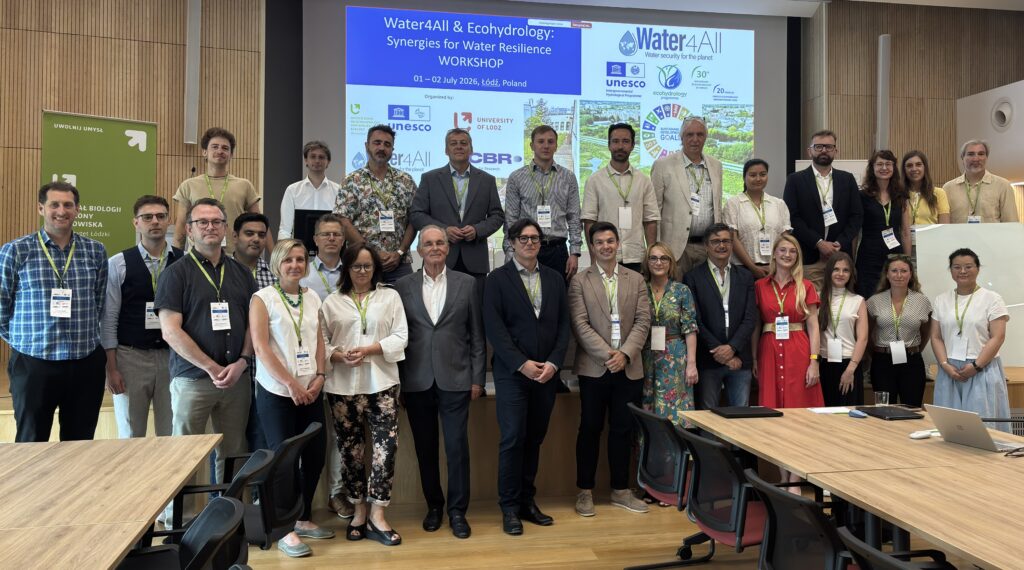
An international workshop held in Łódź, Poland, on 1–2 July 2026 brought together representatives of the Water4All Partnership, UNESCO, research funding organisations and European research projects to explore how transdisciplinary ecohydrology can strengthen water resilience and accelerate progress towards the Sustainable Development Goals (SDGs).
The international workshop, “Water4All and Ecohydrology: Synergies for Water Resilience”, was organised by the UNESCO Chair on Ecohydrology and Applied Ecology at the University of Lodz, within the framework of the Water4All-funded SPRINGINESS project.
The event brought together representatives of eight Water4All research projects, the Water4All Partnership, UNESCO, the Polish Ministry of Infrastructure, research funding agencies and the scientific community. Discussions focused on strengthening cooperation between European water research initiatives and the UNESCO Intergovernmental Hydrological Programme (IHP), particularly its Ecohydrology Programme.
Connecting Scientific Excellence with Global Water Priorities
The workshop was opened by Professor Maciej Zalewski, Vice-Chairperson of the UNESCO IHP Intergovernmental Council and founder of the UNESCO Chair on Ecohydrology at the University of Lodz.
In his keynote lecture, Professor Zalewski highlighted the importance of transdisciplinary ecohydrology as a systemic approach to addressing interconnected challenges related to water resources, ecosystems and human well-being. He emphasized the need to integrate hydrological, ecological and socio-economic knowledge to develop innovative Nature-based Solutions (NbS) that enhance ecosystem resilience and support sustainable development.
The discussions also benefited from contributions by Benjamin Lopez, CEO of the Water4All Partnership, together with Stefano Fazi and Enrique Navarro, who presented the partnership’s strategic directions and opportunities for strengthening the contribution of European research projects to the SDGs and UNESCO priorities.
Representatives of eight Water4All projects shared their research objectives, approaches and results. Among them were two projects implemented at the University of Lodz: SPRINGINESS, led by Professor Tomasz Jurczak, and SentinelSprings, led by Professor Marcin Kiedrzyński.
A central message of the workshop was that scientific excellence alone is insufficient to address today’s complex water challenges. Effective solutions require transdisciplinary collaboration among researchers, policymakers, funding institutions, businesses and local communities, ensuring that scientific knowledge is translated into practical action and measurable societal benefits.
Celebrating 30 Years of UNESCO Ecohydrology and 20 Years of Demonstration Sites
The workshop also contributed to the celebrations of two important milestones: the 30th anniversary of the UNESCO Ecohydrology Programme and the 20th anniversary of the UNESCO Ecohydrology Demonstration Sites Network.
The global network, comprising 66 demonstration sites across 37 countries, provides an international platform for testing, demonstrating and transferring ecohydrological approaches to sustainable water resources management.
On the second day, participants visited the UNESCO Ecohydrology Demonstration Site in Radom, Poland, where the UNESCO Chair on Ecohydrology and Applied Ecology and its partners implemented innovative solutions under the LIFE RadomKlima project.
The technical visit showcased practical applications of ecohydrology for urban climate adaptation, including:
- A Sequential Sedimentation–Biofiltration System (SSBS) designed to reduce pollutant loads entering an urban recreational reservoir.
- A multifunctional floodplain polder along the Cerekwianka River, developed to reduce urban flood risk.
- Additional blue-green infrastructure and ecosystem-based solutions supporting urban water management.
The visit demonstrated how ecohydrological principles can be translated into operational infrastructure that supports water quality improvement, flood risk reduction and urban resilience.
From Research Collaboration to Practical Impact
The workshop identified opportunities for strengthening cooperation between the Water4All Partnership and the UNESCO Ecohydrology Programme, particularly through the exchange of scientific knowledge, the development of Nature-based Solutions and the integration of research outcomes into water management policies.
The workshop was supported by the Water4All Partnership and organised with the participation of the Polish Ministry of Infrastructure. Tomasz Wenecki, Deputy Director of the Water Management Department, delivered a welcome message on behalf of the Minister of Infrastructure, Dariusz Klimczak, emphasising the importance of cooperation between science, public administration and international partners.
The meeting was moderated by Dr. Paweł Jarosiewicz from the UNESCO Chair on Ecohydrology and Applied Ecology at the University of Lodz.
The workshop demonstrated the potential of closer cooperation between UNESCO IHP and Water4All to connect scientific innovation with practical implementation, strengthen international research partnerships and advance transdisciplinary approaches to water security and ecosystem resilience.
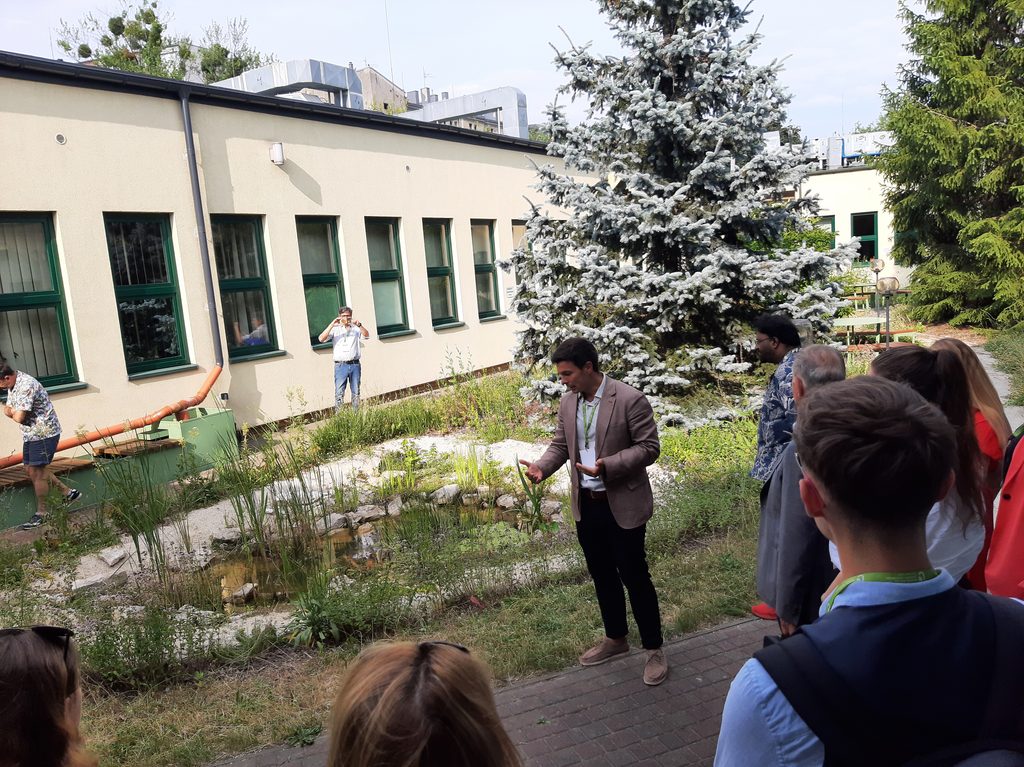
Visitation on the Water4All Springiness site at University of Lodz Campus.