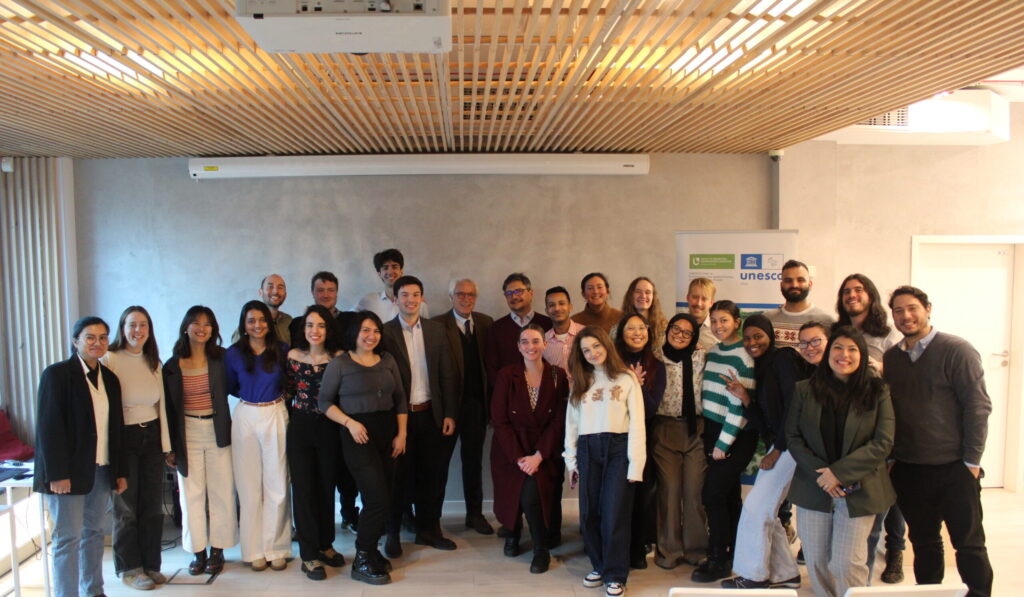
As part of the 50th Anniversary of the UNESCO Intergovernmental Hydrological Programme (IHP) and the 60th Anniversary of UNESCO’s engagement in water sciences, the Ecohydrology Youth Network (EHYN) organized an international scientific seminar on February 7, 2025, at the University of Łódź in Poland. This event focused on sustainable water resource management through ecohydrology, bringing together experts, researchers, and participants from the Erasmus Mundus Master in Applied Ecohydrology program to share their perspectives on global water challenges. Special attention was given to rivers, which, despite being fundamental to landscapes, have suffered significant degradation in recent decades due to human activities and climate change.
The seminar featured a keynote address by Dr. Elfithri Rahmah, Chief of Section, Capacity Development and Water Family Coordination, Division of Water Sciences at UNESCO IHP. The event also provided an opportunity to celebrate the achievements of Dr. Giuseppe Arduino, former Head of the Ecohydrology Section at UNESCO IHP, who was awarded the Universitatis Lodziensis Amico Medal in recognition of his long-term support for the development of ecohydrology. This field, which aims to integrate hydrology and ecology to enhance water sustainability, has been intensively developed at the University of Łódź since the 1980s by Professor Maciej Zalewski and his team.
A key topic of discussion was the WBSRC concept (Water, Biodiversity, Ecosystem Services, Resilience, Culture), an innovative approach to sustainable water management derived from ecohydrology, which is currently at the forefront of UNESCO IHP Phase IX. Young researchers presented case studies in a geographical sequence, covering rivers from the Thames in England, across Europe, Asia, and Australia, to North and South America.
In conclusion, participants agreed that, in the face of global change and an accelerating water crisis, there is an urgent need to recognize the complex relationship between humans and the biosphere. Water plays a fundamental role in bioproductivity, biodiversity, and nutrient cycles, which are essential life-supporting processes. According to the theory of ecohydrology, one of the greatest challenges in sustainable water resource management is how to simultaneously increase water quantity and quality while also enhancing biodiversity, ecosystem services for society, and resilience to environmental impacts. This holistic vision of interconnected catchment processes can be realized through nature-based and ecohydrological solutions (NBS) and systemic, catchment-scale approaches. These methods recognize water ecosystems as both recipients and producers of water and emphasize the importance of societal engagement through culture and education. Culture (C) is deeply embedded in societal behaviors, shaping perceptions, actions, and the overall effectiveness of sustainability initiatives.
The seminar gathered 65 online participants and 54 in-person attendees. It was moderated by Dr. Paweł Jarosiewicz, Chairperson of EHYN and assistant professor in ecohydrology at the University of Łódź and the European Regional Centre for Ecohydrology of the Polish Academy of Sciences. The event aimed to raise awareness of global water challenges and inspire younger generations to take action in implementing ecohydrology science in practice.
The Ecohydrology Youth Network (EHYN) is a youth-led network focused on fostering global youth engagement in ecohydrological nature-based solutions. Its mission is to facilitate youth involvement in UNESCO’s ecohydrology-related initiatives and contribute to achieving key objectives outlined in the UNESCO IHP-IX Strategic Plan, Science for a Water Secure World in a Changing Environment. Registration for EHYN is open here: https://forms.office.com/pages/responsepage.aspx?id=Uq5PHbM5-kuwswIpVrERlKl1dpebbrBDuVE453Tg109UOTUxMVpORTUzNUxIVlg3SFVERDlEWFJFVi4u&route=shorturl
Comment from LinkedIn:
“A big thank you to those who organized and attended the event. It was a great morning! The huge range of case studies presented provided valuable insights into different approaches to water management.” – Sophie Mulligan, EHYN member, Erasmus Mundus MAEH Programme student.