Project Overview
Urban and suburban catchments Ecohydrology approach was implemented in the city area – 112 km2 Ecohydrological solutions have been demonstrated at the level of: * Urban catchment * Rivers (Mleczna, Cerekwianka, Potok Północny) * Urban reservoir “Borki” – major recreational site in Radom City * Small blue-green infrastructure located in several places in the city center
Ecosystem Services
Provisioning
- Provisioning Services are ecosystem services that describe the material or energy outputs from ecosystems. They include food, water and other resources.
Regulating
- Regulating Services are the services that ecosystems provide by acting as regulators eg. regulating the quality of air and soil or by providing flood and disease control.
- Moderation of extreme events: Extreme weather events or natural hazards include floods, storms, tsunamis, avalanches and landslides. Ecosystems and living organisms create buffers against natural disasters, thereby preventing possible damage. For example, wetlands can soak up flood water whilst trees can stabilize slopes. Coral reefs and mangroves help protect coastlines from storm damage.
- Waste-water treatment: Ecosystem
Habitat / Supporting
- Ecosystem services "that are necessary for the production of all other ecosystem services". These include services such as nutrient recycling, primary production and soil formation.
Cultural
- Cultural Services corresponds nonmaterial benefits people obtain from ecosystems through spiritual enrichment, cognitive development, reflection, recreation, and aesthetic experiences.
Major Issues
—
No issues provided.
EH Engineering Solutions
Following the ecohydrology concept, the hydrological assessment
Following the ecohydrology concept, the hydrological assessment was first step to analyse the risk in urban catchment. In particular, project has focused on the climate change (CC). Vulnerability assessment of the Radom urban space was conducted with the following: 1) Elaboration of the vulnerability assessment methodology. The methodology for the vulnerability assessment was elaborated based on the review of literature on this topic, existing case studies and experiences in other projects, and the review of the existing methodologies for the vulnerability assessment in the urban space, with the emphasis on the four key areas: 1. water: water ecosystems. 2. grey infrastructure. 3. green infrastructure. 4. socio-economic aspects. 5. potential to provide ecosystem services and support biodiversity.
Radom has a 4.8% share of parks,
Radom has a 4.8% share of parks, green areas and estate green areas in the total area, which is a much higher percentage than the average for Poland cities (0.2%). The legally protected areas cover an area of 378.96 ha, which is 3.39% of the total area of the city of Radom. In Radom there are: - ecological use "Bagno" located which covers an area of 6.86 ha, - protected landscape area called "Kosówka Valley" with an area of 246 ha, - Natura 2000 area Ostoja Kozienicka PLB140013 - 126 ha.
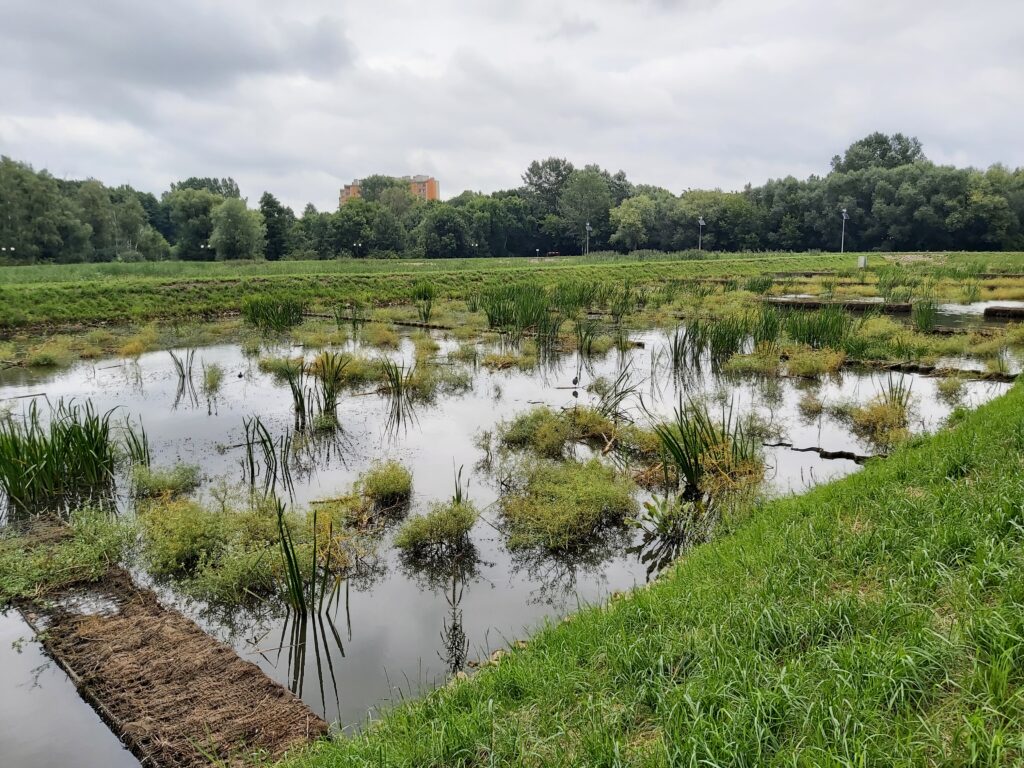
Multiple Ecohydrological Nature-based Solutions (Ecohydrological biotechnologies) have
Multiple Ecohydrological Nature-based Solutions (Ecohydrological biotechnologies) have been implemented, including Sequential Sedimentation Biofiltration System and renaturalization of river to restore its natural retention capacity. The effectiveness of the sequential sedimentation bio filtration system (SSBS) has been confirmed in the framework of the LIFE + (LIFE08 ENV / EN / 000517) project, where it was constructed and tested for water purification of recreational reservoirs in Łódź.
Project Activities
-
* Implementation of the EH-NBS (e.g. SSBS, ClimaPond, Treetrench, ClimaBOX)
-
* Education and stakeholders engagement to water management
-
* Climate adaptation in urban area with blue-green infrastructure
Expected Outcomes
* Demonstration of the ecohydrological approach to adapt cities to climate change. | The final project conference will be held on 24th of November 2022. Final report of the project will be available soon. Then, more than 3 research articles are planned to be finalized and published in prestigious scientific journals, to increase the impact of demosite. Publication of leaflets and brochures with project results.